Official Publication
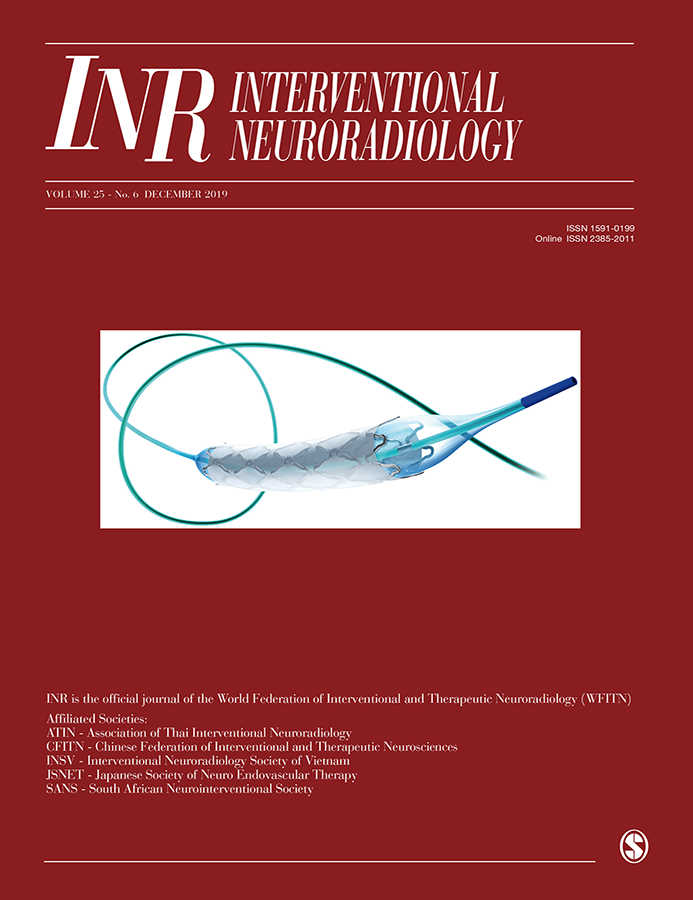
Interventional Neuroradiology — INR Journal
The peer-reviewed official journal of WFITN, publishing original research, reviews, and case reports in neurointervention since 1995. It is the leading international publication dedicated to the science and practice of interventional and therapeutic neuroradiology.
About the Journal
Science at the forefront of neurointervention
Interventional Neuroradiology (INR) is a peer-reviewed clinical practice journal documenting the current state of interventional neuroradiology worldwide.
INR publishes original clinical observations, descriptions of new techniques or procedures, case reports, and articles on the ethical and social aspects of related health care. Original research published in INR is related to the practice of interventional neuroradiology.
- Publisher
- SAGE Publications
- ISSN
- 1591-0199
- Indexed in
- PubMed / MEDLINE, Scopus
Become a member of the WFITN and get access to the INR Journal. Already have an account? Login to your account.
Linkage of the journal to our website is currently underway by Sage.
Scope
Topics covered by the journal
From the Journal
Original Research Article
Optimal pinching technique for recanalization: A retrospective analysis of mechanical thrombectomy in a 3D vessel model
Summary: Achieving recanalization with the fewest possible passes is critical for good outcomes in mechanical thrombectomy, yet reasons for failure are often unclear. Using a 3D silicone cerebrovascular model and swine thrombi, 109 procedures were performed and fluoroscopic videos were analyzed. In cases using the pinching technique, advancing the aspiration catheter to secure firm thrombus contact improved first pass success. Pulling the stent retriever toward the aspiration catheter after contact increased effectiveness, achieving first pass recanalization in all cases. These maneuvers likely prevent thrombus stretching, maintain contact, and enable more effective pinching during retrieval, leading to higher first pass recanalization rates.
Impression: This study provides a clear and practical insight into why first pass recanalization succeeds or fails during the pinching technique. The Blind and Replay model is innovative and helps bridge the gap between operator perception and actual device behavior. The findings offer concrete, reproducible technical tips that are directly applicable to daily practice and contribute meaningfully to optimization of combined thrombectomy techniques. (Commented by: Shinichi Yoshimura, Hyogo Medical University, Japan)
From Yoichiro Kawamura, Medical Affairs/CMO Office, Johnson & Johnson K.K. Medical Company, Tokyo, Japan.
View at: doi.org/10.1177/15910199251405097